A Chesapeake Pipe & Cigar Educational Article
Understanding the remarkable chemistry that transforms tobacco into the flavors, aromas, and smoking experiences associated with fine cigars and tobacco pipes.
Every great cigar and carefully prepared bowl of pipe tobacco begins with the craftsmanship of growers, curers, blenders, and makers. But the final transformation happens when tobacco meets heat.
That transformation is largely driven by a fascinating chemical process called pyrolysis.
Understanding pyrolysis helps explain why tobacco produces such complex aromas, why cigars and pipes behave differently, and why the pace at which we smoke can dramatically change the experience.
What Is Pyrolysis?
Pyrolysis is the thermal decomposition of organic material through heat, typically in an environment with little or insufficient oxygen for complete combustion.
When tobacco is heated, its complex organic compounds begin to break apart and undergo chemical reactions. These reactions create a remarkable variety of gases, vapors, and other compounds, some of which contribute to the characteristic aroma and sensory qualities of tobacco smoke.
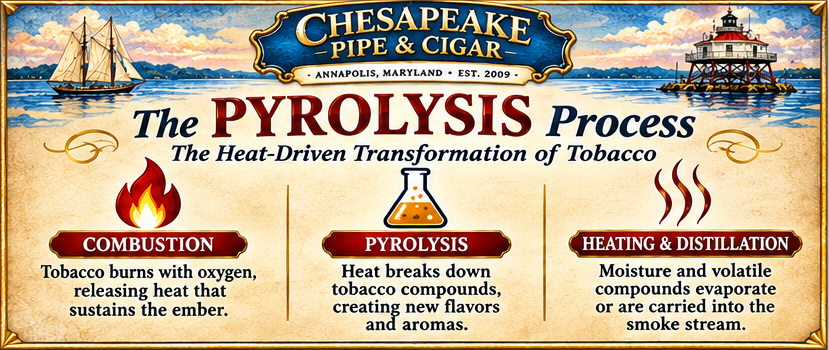
Three closely related processes occur during smoking:
Combustion: Tobacco reacts with oxygen, releasing heat and sustaining the burning ember.
Pyrolysis: Heat breaks down tobacco compounds, creating new chemical substances without requiring direct contact with oxygen.
Heating and distillation: Moisture and volatile compounds evaporate or are carried into the smoke stream as heat moves through the tobacco.
These processes overlap. The burning tip of a cigar or the ember in a pipe bowl is not one uniform temperature, but a collection of constantly changing thermal zones.
The Role of Moisture: Why Proper Humidification Matters to Pyrolysis
Moisture plays a surprisingly important role in the chemistry of tobacco combustion and pyrolysis. Before tobacco can undergo significant thermal decomposition, much of its moisture must first be heated and evaporated. Because evaporation absorbs energy, moisture influences how quickly tobacco heats, how the burning ember develops, and how heat travels through the surrounding leaves. Proper moisture conditioning helps establish a more consistent balance between combustion, pyrolysis, and the release of volatile compounds that contribute to tobacco’s distinctive aromas.
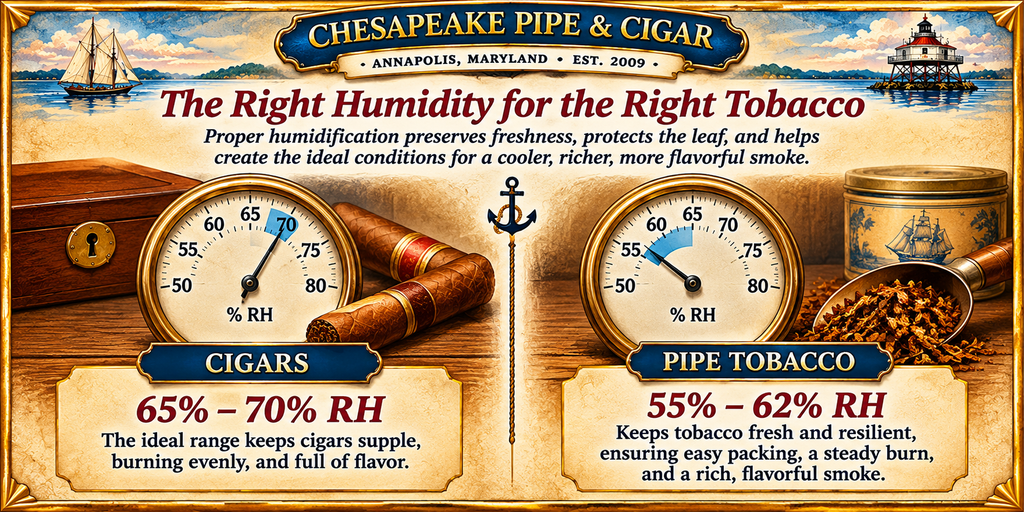
In cigars, proper humidification helps preserve the delicate relationship between combustion and pyrolysis. Tobacco that has become excessively dry can burn rapidly, producing hotter, less controlled smoking conditions and potentially harsher sensations. Conversely, an overly humidified cigar may resist ignition, require frequent relighting, and burn unevenly. Excess moisture also consumes additional heat as it evaporates, changing the temperature distribution around the ember. A properly conditioned cigar generally burns more consistently, allowing its carefully selected tobaccos to undergo thermal transformation under more predictable conditions.
Pipe tobacco presents a slightly different challenge because moisture content varies considerably among blends and tobacco preparations. A heavily cased aromatic, a pressed Virginia flake, and a traditional English mixture may behave quite differently when exposed to heat. Excessively moist pipe tobacco can require repeated relights, generate additional steam and condensation, and contribute to gurgling or uncomfortable smoking sensations. Tobacco that is too dry, meanwhile, may burn too readily and become difficult to manage. Finding an appropriate moisture level for a particular blend helps maintain a more controlled ember and a steadier progression of heating and pyrolysis through the bowl.
Interestingly, more moisture does not automatically mean cooler smoke, nor does drier tobacco necessarily produce better flavor. Moisture affects heat transfer, evaporation, combustion efficiency, and the chemical reactions occurring within the tobacco. The ideal condition is therefore not a single universal humidity percentage, but a balance suited to the tobacco’s composition, preparation, and intended smoking characteristics.
Ultimately, proper humidification is about more than keeping tobacco fresh. It helps preserve the physical qualities of the leaf while influencing the thermal environment in which combustion and pyrolysis occur. At Chesapeake, we consider thoughtful tobacco conditioning an essential part of appreciating the grower’s harvest, the blender’s craftsmanship, and the fascinating science that unfolds when tobacco meets heat.
How Pyrolysis Works in a Cigar
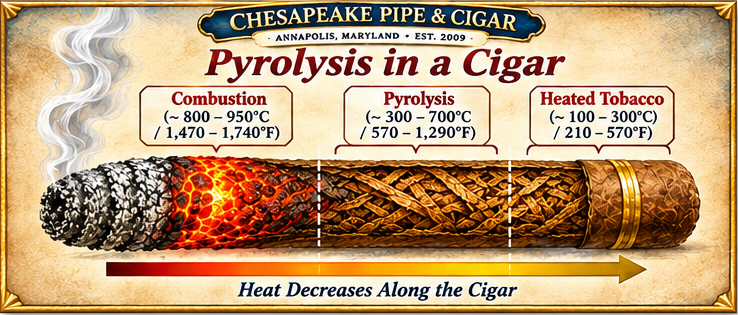
A cigar is an especially interesting example because its construction creates a progression of temperature zones along its length.
1. The Combustion Zone
At the burning end, oxygen reacts with tobacco and produces the heat needed to keep the cigar lit.
Temperatures vary substantially depending on airflow and puffing intensity. The hottest areas can reach approximately 800–950°C (1,470–1,740°F), particularly during a draw.
This is the engine that powers the entire process.
2. The Pyrolysis Zone
Immediately behind the burning region, tobacco is heated without necessarily receiving enough oxygen to burn completely.
Across a broad temperature range, often approximately 300–700°C (570–1,290°F), organic tobacco constituents undergo thermal decomposition and rearrangement.
This is where many of the chemical compounds carried in smoke are formed.
3. The Heated Tobacco Zone
Farther behind the ember, temperatures are lower. Moisture and volatile constituents can evaporate, and some compounds may be transferred into the passing smoke.
This zone is especially important because cigar smoke travels through the unburned tobacco before reaching the smoker.
That journey can change the smoke through cooling, condensation, filtration, and additional chemical interactions.
Why a Cigar Changes as You Smoke It
As the burning front advances, the remaining tobacco becomes shorter and its thermal history changes.
The smoke may become warmer, moisture and condensates may accumulate, and the balance of compounds reaching the palate can shift.
This helps explain why a cigar may seem different in its opening, middle, and final portions, although changes in flavor are also influenced by tobacco blending, construction, puffing, and individual perception.
How Pyrolysis Works in a Tobacco Pipe
A tobacco pipe operates according to the same basic chemistry, but the geometry of the bowl creates a different environment.
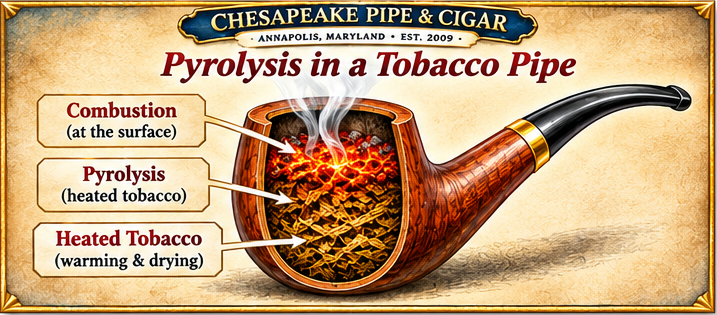
1. Combustion Near the Surface
When the pipe is lit, a burning region develops near the exposed tobacco surface.
As air is drawn through the bowl, oxygen supports combustion and the ember advances into the tobacco.
Unlike a cigar, the burning region is largely confined within the bowl.
2. Pyrolysis Beneath and Around the Ember
Heat transfers into nearby tobacco, causing organic materials to decompose before they are fully exposed to oxygen.
The resulting vapors and gases join the smoke stream, while some compounds undergo further reactions as they pass through hotter regions.
3. Heating of the Surrounding Tobacco
Tobacco farther from the ember may warm, lose moisture, and release volatile substances.
Because the bowl contains tobacco at different stages of heating, the smoking experience evolves as the ember moves downward.
The bowl’s shape, chamber diameter, packing density, moisture content, and airflow can all influence this progression.
Why Smoking Tempo Matters
One of the most practical lessons of pyrolysis is that the way tobacco is smoked affects the conditions under which its compounds are formed.
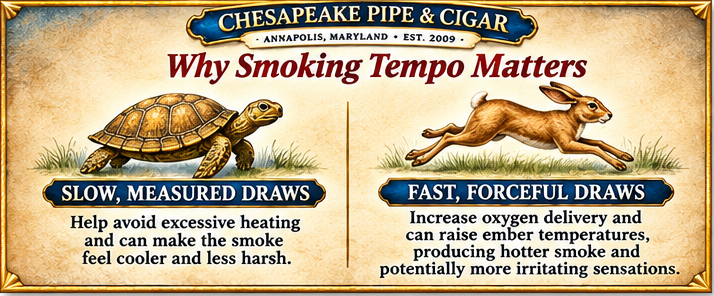
Slow, Measured Draws
Moderate puffing generally helps avoid excessive heating and can make the smoke feel cooler and less harsh.
Fast, Forceful Draws
Frequent or intense puffing increases oxygen delivery and can raise ember temperatures, producing hotter smoke and potentially more irritating sensations.
The principle is straightforward: combustion supplies the heat, while heat influences the pyrolysis reactions that follow.
However, a cooler-feeling smoke is not necessarily a safer smoke. Tobacco smoke contains toxic substances under all ordinary smoking conditions, and changing puffing technique does not eliminate those risks.
What Creates Tobacco’s Complex Aromas?
Tobacco contains many substances that can participate in thermal reactions, including carbohydrates, proteins, amino acids, organic acids, and other naturally occurring constituents.
Heating can create or release a wide range of compounds, including carbonyls, phenols, organic acids, and numerous aromatic molecules.
Some of these contribute to sensory impressions commonly described as:
- Cocoa: Dark, roasted, bittersweet impressions.
- Roasted nuts: Toasted, earthy, or nutlike notes.
- Herbs and spice: Aromatic, peppery, or botanical characteristics.
- Coffee: Roasted, rich, or slightly bitter impressions.
- Vanilla: Sweet, creamy, or fragrant associations.
- Wood and earth: Woody, mineral, or earthy qualities.
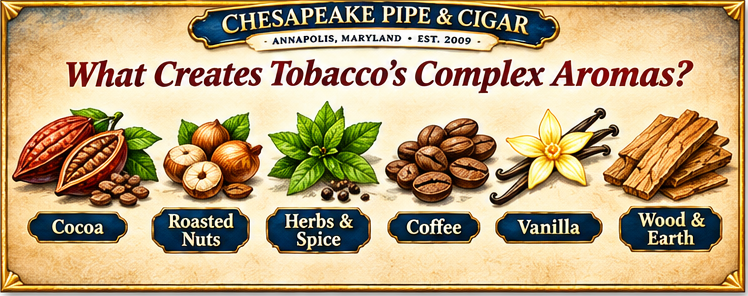
These descriptors do not necessarily mean that cocoa, coffee, vanilla, or nuts are present in the tobacco. They describe sensory associations arising from complex mixtures of compounds.
Pyrolysis is also responsible for forming harmful constituents, including carbon monoxide and certain carcinogenic substances. The chemistry that produces distinctive aromas is not separate from the chemistry that makes smoke hazardous.
Cigars Versus Pipes: What’s Different?
Although cigars and pipes rely on the same fundamental chemistry, their physical construction creates different smoking environments.
Cigars: The burning region advances along the cigar. Air and smoke pass through the remaining tobacco, where additional heating, cooling, condensation, and filtration can occur. Construction, moisture, draw resistance, and puffing behavior all influence the process.
Tobacco pipes: The burning region progresses through tobacco contained within a bowl. Packing density, chamber dimensions, moisture, airflow, and the movement of the ember affect how the tobacco heats and decomposes.
Both rely on combustion to sustain the ember and pyrolysis to transform tobacco’s organic constituents. The differences arise primarily from their physical construction and the way heat and air move through the tobacco.
The Chesapeake Take: There’s More to the Smoke Than Meets the Eye
Every great smoke has a story, and some of its most fascinating chapters are written in the chemistry of fire and leaf.
From the grower’s fields and the blender’s art to the glowing ember of a fine cigar or a favorite pipe, pyrolysis is the remarkable transformation that brings tobacco’s complex character to life. The delicate interplay of heat, moisture, airflow, and smoking tempo helps explain why every blend, every pipe, and every cigar offers a distinctly different experience.
At Chesapeake, we believe that understanding the science only deepens our appreciation for the centuries of craftsmanship and tradition behind it. There’s something wonderfully satisfying about discovering why the things we enjoy behave as they do.
But the best discoveries aren’t made by reading alone. They’re made through conversation, shared experiences, and a willingness to explore something new.
So bring your curiosity to Chesapeake Pipe & Cigar. Pull up a chair in our Annapolis lounge, strike up a conversation with our knowledgeable team, and explore the remarkable world of pipes, cigars, and tobacco with people who share your passion for discovery.
Because at Chesapeake, we don’t simply share our knowledge. We invite you to become part of the experience.
Educational note: The temperatures discussed are approximate, vary with smoking conditions, and should not be interpreted as fixed boundaries. Tobacco smoke contains toxic and carcinogenic substances, and no smoking technique eliminates those hazards.