Description
An elegant evolution of one of the most celebrated innovations in pipe-making history, the Peterson System Spigot combines the time-honored engineering of Charles Peterson’s revolutionary System design with the distinguished craftsmanship of traditional Irish silversmithing.
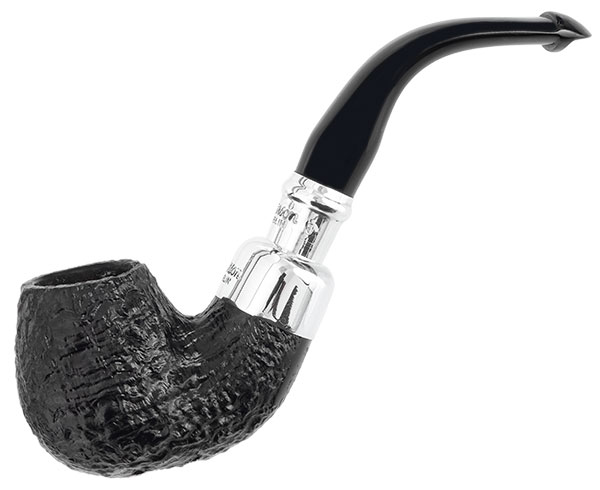
The 317 Bent Billiard is a particularly handsome example of Peterson’s signature shaping aesthetic. Its gracefully bent profile, compact proportions and classic Billiard bowl create a timeless silhouette that is both refined and unmistakably Peterson. A richly textured, jet-black sandblasted finish accentuates the natural grain of the briar, while the brilliant sterling silver spigot mount provides a striking contrast, lending the pipe the sophisticated appearance of a traditional dress pipe.
Unlike the nickel-mounted System Standard, the System Spigot features sterling silver fittings on both the shank and stem, creating a distinctive and mechanically robust military-style mount. This configuration allows the stem to be removed even while the pipe is warm, a practical advantage of the design.
First introduced in 2015, the System Spigot series represents a marriage of Victorian-era engineering and contemporary Irish craftsmanship. Its combination of richly textured briar and polished sterling silver pays tribute to Peterson’s longstanding silversmithing tradition.
The Legendary Peterson System
Few innovations in the history of tobacco pipe manufacturing have proven as enduring as the Peterson System. Developed by Charles Peterson in Dublin, Ireland, during the late nineteenth century, the design addressed several of the mechanical shortcomings associated with conventional tobacco pipes, most notably the accumulation of moisture within the airway.
After spending approximately 15 years manufacturing and repairing pipes for the Kapp brothers, Charles Peterson introduced a series of engineering innovations that would forever define the Peterson marque.
The Original System Patents
-
1890 | British Patent No. 12,393: Granted on August 8, 1890, this foundational patent introduced the internal moisture reservoir, elevated draft hole and graduated airway that formed the basis of the Peterson System.
-
1891 | International Patent Expansion: French Patent No. 210,944 was granted on January 22, 1891, and an American patent application was filed on September 2 of that year.
-
1894 | British Patent No. 9,059: Granted on May 7, 1894, this patent introduced refinements to the mouthpiece, establishing the foundation for the distinctive Peterson Lip. The original System invention also received United States Patent No. 519,135 on May 1, 1894.
- 1898 | British Patent No. 18,827: Granted on September 3, 1898, this final patent refined the distinctive P-Lip mouthpiece, completing the evolution of Charles Peterson’s original System design.
The Engineering Behind the Peterson System
The traditional Peterson System incorporates several interconnected design elements, each serving a specific mechanical purpose.
The Moisture Reservoir
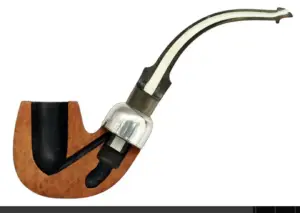
A specially drilled chamber positioned beneath the elevated draft hole provides a collection point for condensation. Rather than allowing accumulated moisture to travel directly through the stem, the reservoir provides a separate space where it can collect.
The Graduated Bore Mouthpiece
The internal airway progressively narrows from the tenon toward the mouthpiece opening. This graduated construction works in conjunction with the reservoir and is intended to help manage airflow and condensation.
The Patented P-Lip Mouthpiece
Perhaps the most recognizable feature of the Peterson System, the P-Lip incorporates an upward-facing aperture rather than the forward-facing opening found on a conventional fishtail mouthpiece. Its purpose is to redirect the smoke toward the palate rather than directly onto the tongue.
The Condenser
In the traditional System configuration, a tenon extension projects into the upper portion of the reservoir, helping direct condensation into the chamber. The construction of this component varies among Peterson’s different System series.
The Military Mount
Although not exclusive to Peterson or part of the original patented innovations, the tapered military mount remains an important element of the traditional System. A metal reinforcement surrounds the briar mortise, while the tapered stem connection permits disassembly without placing the same stresses on the shank as a conventional straight tenon.
A Living Piece of Irish Pipe-Making History
More than 135 years after Charles Peterson secured his original patent, the System remains a remarkable example of nineteenth-century ingenuity. Its engineering has influenced not only the internal construction of Peterson pipes but also their distinctive appearance, including their substantial shanks, generous bends and muscular transitions.
The System Spigot Sandblasted 317 brings together that historic design heritage, traditional briar craftsmanship and the unmistakable elegance of Irish sterling silver.
Made in Dublin, Ireland, it represents another chapter in one of the most enduring stories in the history of pipe making.